PDF
Musique
The Reverse Solfeggio V.3.0
[youtube]https://www.youtube.com/watch?v=P0VCJ5MFXcU[/youtube]
Description of The Reverse Solfeggio V.3.0
The Reverse Solfeggio V.3.0 is the most advanced and complete formulation of the mirror‑based musical system developed by l’Architech (Gabriel Breton‑Breault). This version consolidates the foundational principles of musical inversion and expands them into a fully bidirectional framework capable of transforming every dimension of sound: time, harmony, dynamics, phase, rhythm, tempo, and chord structure.
V.3.0 introduces several major innovations:
Full multidimensional inversion, acting simultaneously on temporal flow, harmonic direction, dynamic contour, phase polarity, and timbral hierarchy.
Structural inversion of tempo and chords, where rhythmic and harmonic material is played backward before being reinverted, producing the unique phenomenon of inverted percussion within a normal melodic structure.
Bidirectional superposition, allowing a direct melody to be played simultaneously with its inverted mirror version, creating hybrid textures of sonic matter and harmonic antimatter.
A complete mirror‑notation system, including inverted clefs, reversed note heads, directional symbols, antimatter markers, and mixed staves for dual‑direction compositions.
Inverted scales and modes, redefining tonal gravity, modal color, and interval function through reversed tension pathways.
Expanded applications, ranging from composition and pedagogy to psychoacoustics, digital audio engines, spatialization systems, and experimental performance environments.
With V.3.0, Reverse Solfeggio becomes a fully operational musical language, capable of describing and generating structures impossible to represent with traditional notation or theory. It reveals hidden symmetries in existing works—such as Pachelbel’s Canon—and offers composers a new creative dimension where music can unfold forward and backward simultaneously.
More than a theoretical innovation, The Reverse Solfeggio V.3.0 proposes a new way of understanding sound itself, echoing the fundamental symmetries of nature: temporal inversion, polarity, expansion and contraction, and geometric reflection. It stands as a conceptual bridge between music, physics, and perception, redefining the relationship between time, harmony, and reality.
Taille :
193,06 Ko
Vues :
152
Téléchargements :
3
♥
0
PDF
Cosmologie
(E = Mc²) / n^∞ : The Cyclic Universe
Introduction
In this directional cosmological model, I describe the universe as a cyclic structure entirely governed by the fundamental relation E = Mc², extended into its dynamic form (E = Mc²) / n^∞ to represent dimensional collapse, and into its inverse form n^∞ = E = Mc² to represent cosmic reconstruction. When n → ∞, energy fragments, mass tends toward zero, light ceases to be confined, internal geometry collapses, and dimensions disappear, defining the zero‑state of the cosmos. When n^∞ = E, geometry reforms instantly, the God Particle reappears, light is captured, mass is reborn, and the directional spirals Φ and −Φ separate to initiate a new cycle. This document presents the complete mechanics of the cosmic cycle: directional separation, fractal expansion, formation of binary systems, convergence, collision, dimensional collapse, infinite fragmentation, geometric reconstruction, cosmic explosion, and new Φ / −Φ separation. The universe is not born once; it is born at every cycle, following a fractal, stable, and eternal dynamic inscribed in the geometry of energy itself.
Taille :
275,73 Ko
Vues :
246
Téléchargements :
3
♥
0
PDF
Théorie directionnelle
The True Dark Matter
A black hole (black sphere) is not merely a gravitational singularity: it is the densest, most massive, and most saturated physical object in the universe. In directional cosmology, the black sphere represents the final state of matter, the state in which all internal dimensions are saturated, directional geometry collapses, and no vibration, emission, or luminous interaction remains possible.
For nearly a century, classical cosmology has searched for an invisible form of matter to explain phenomena it could not understand: excessively high rotation speeds, missing mass, immense gravitational halos, accelerated expansion. It named this entity dark matter, without ever detecting it, defining it, or observing it. In a directional universe, this confusion disappears immediately:
👉 the true dark matter is the saturated matter of black spheres.
The matter inside a black sphere is the heaviest matter that can exist. It is confined in a state where:
• density reaches its directional maximum,
• internal dimensions are fully saturated,
• directional tension is maximal,
• internal geometry is collapsed,
• no light can be emitted or transmitted.
This matter is:
• real,
• massive,
• invisible,
• undetectable,
• confined,
• geometrically saturated.
It is exactly what cosmology has been searching for over the past century — but it did not know where to look.
In directional physics, the mass of a black sphere is not merely a quantity:
👉 it is a direct indicator of metric compression and dimensional saturation.
Knowing the mass of a black sphere makes it possible to determine:
• the actual contraction of space time,
• the local directional deformation,
• the internal curvature,
• the saturated density,
• and therefore the true shortest possible distance — the one light never reveals.
Light reveals a distorted path. Saturated matter reveals the real path.
Thus, dark matter is not a mysterious substance dispersed throughout the universe:
👉 it is the heaviest matter, confined within black spheres, and it makes it possible to measure the real structure of space time.
This introduction establishes the framework: true dark matter is the saturated matter of black spheres, and it reveals real distances, internal tensions, hidden geometries, and the supraluminal dynamics of the universe.
Taille :
4,05 Mo
Vues :
304
Téléchargements :
7
♥
0
PDF
Cosmologie
The Speed Greater Than C in a Supraluminal Universe
In classical physics, the speed of light Cis considered an insurmountable limit. No object, no information, no interaction can exceed this value. This assertion relies on a simplified vision of space time: a neutral, motionless framework, devoid of torsion, rotation, or internal deformation. In a directional universe, this assumption collapses.
The speed Cis not a cosmic limit: it is the internal speed of the photon in an undeformed space time. As soon as the metric dilates, contracts, twists, or reorients, the apparent speed of light C_vvaries, modifying the trajectory, the angle of arrival, the observed distance, and the perceived velocity of galaxies. In this context, the reduction or increase of distance between two objects can exceed Cwithout either of them surpassing this speed locally.
Two photons moving away from each other at Cproduce a spacing speed of 2C. Two photons approaching each other reduce their distance at 2C. An observer traveling at Ctoward a galaxy rushing toward him reduces the distance at a speed greater than C. These phenomena violate no law: they reveal the directional structure of the universe.
The speed greater than Cis not a surpassing of C. It is a geometric consequence of a living space time, where real distances differ from luminous distances, and where cosmic dynamics can only be understood by integrating the directional metric, universal rotation, and the internal propulsion of structures.
This introduction establishes the framework: in a directional universe, speeds greater than Care natural, coherent, and inevitable.
Taille :
265,32 Ko
Vues :
298
Téléchargements :
4
♥
0
PDF
Cosmologie
Directional Cosmic Expansion
The expansion of the universe, as described by classical models, relies on the assumption that galaxies move away from one another under the effect of a uniform dilation of space. This simplified view does not account for the living geometry of space time, nor for the directional forces that shape real cosmological dynamics. In a deformed universe, light never carries pure information: its trajectory bends, its frequency changes, its apparent speed varies, and its internal time is deformed according to the metric it traverses. Thus, the observed recession speed of a galaxy is not necessarily its real speed.
Cosmic expansion is influenced by two fundamental engines: the global rotation of the universe and the directional propulsion generated by the supermassive black holes at the centers of galaxies. Cosmic rotation induces a universal centrifugal force, pushing structures outward along precise geometric axes. Black holes, for their part, do not merely attract matter: they deform the local metric, creating a directional tension capable of propelling their galaxy through space time. These two dynamics overlap, reinforce, or oppose each other, producing an expansion that is neither uniform nor isotropic.
Within this framework, observed expansion becomes a directional projection, altered by metric deformations, variations of C_v, and curved light trajectories. A galaxy may appear to recede rapidly while its real motion is slow, or appear slow while it is propelled at high speed. The error in estimating cosmic expansion arises directly from this deformed geometry.
This chapter explores this reality: cosmic expansion is not a uniform phenomenon, but a directional dynamic resulting from the rotation of the universe, the propulsion of black holes, and the deformation of space time.
Taille :
308,90 Ko
Vues :
282
Téléchargements :
5
♥
0
PDF
Théorie directionnelle
The Directional Positioning of Galaxies
In a universe where light never follows a straight trajectory, the apparent position of galaxies ceases to be a reliable datum. Every photon reaching the observer has crossed a deformed geometry composed of dilations, contractions, extreme curvatures, and directional variations of C_v. Thus, the direction from which a galaxy appears to originate is not necessarily its true direction.
Space time acts as a living lens, capable of redirecting, inverting, or duplicating light trajectories. A galaxy located to the right may appear on the left. A distant structure may seem close. A single galaxy may be observed twice if two photons from the same object travel along geometrically distinct paths. The visible universe becomes a projected map, altered by the metric, and not a faithful representation of cosmic reality.
Understanding the directional positioning of galaxies means recognizing that classical cosmology rests on a geometric illusion. It means acknowledging that the maps of the universe do not show the real universe, but the universe deformed by the geometry it traverses. It also means placing the observer back into the correct frame: a directional frame in which every position depends on photon dynamics and the fluid structure of space time.
This chapter explores this fundamental idea: the observed position of a galaxy is only a directional projection, not its real position.
Taille :
145,24 Ko
Vues :
221
Téléchargements :
6
♥
0
PDF
Cosmologie
Toward a Deformed Universe
The universe humanity observes is not the real universe: it is the universe filtered, altered, compressed, or stretched by the metric it traverses before reaching the observer. Every photon carrying visual information undergoes a directional transformation dictated by the local geometry of space‑time. Thus, the shapes, distances, velocities, and structures we believe we are measuring are merely distorted projections of an inaccessible reality.
When the apparent speed of light varies, when the metric dilates or contracts, when extreme gravity modifies the photon’s directional dynamics, the observed image ceases to be faithful. Galaxies twist, objects stretch, distances compress, and the visible universe becomes an altered version of itself.
To write a deformed universe is to acknowledge that classical cosmology rests on a metric illusion. It is to accept that light never carries pure information, but information transformed by its journey. It is, finally, to place the observer back into their true frame: a directional, dynamic frame where every quantity depends on the photon’s internal tension and the geometry it traverses.
This work explores this deformed reality and reveals a universe whose true structure remains hidden behind the variable speed of light.
Taille :
191,20 Ko
Vues :
204
Téléchargements :
4
♥
0
PDF
Théorie directionnelle
Incorrect Estimation of Distances
The universe that is observed is not necessarily the real universe: it is the universe filtered through the local metric, through internal dynamics, and through the apparent speed of light that is measured. If the directional speed C_v varies for the observer — while the internal speed C_0 remains constant for the photon — every cosmological distance becomes an interpretation rather than an absolute value.
In a dilated space, local time stretches, light appears to slow down, and distances seem shorter than they truly are. In a contracted space, local time compresses, light appears to accelerate, and distances seem longer. Thus, classical cosmology, founded on a strictly constant speed of light for all observers, produces measurements that do not reflect the directional structure of the universe.
Incorrect Estimation of Distances designates this fundamental error: the observed distance depends on the observer’s metric, whereas the real distance depends on universal dynamics. This divergence opens the way to a directional correction of cosmology, where each measurement must be reevaluated according to the local variation of C_v, directional tension, and the fluid geometry of space time.
Taille :
251,29 Ko
Vues :
203
Téléchargements :
5
♥
0
PDF
Ordinateur photonique
Photon Processor Printing 2.0
Introduction
The Photonic Processor 2.0 represents a new generation of directional architecture designed to use light as the primary vector of computation. Unlike traditional electronic systems, this processor relies on an internal structure entirely sculpted layer by layer from silica prepared according to a strict protocol and guided by ceramic or granite plates pre‑engraved with a laser.
Each layer is printed inside a different plate, selected for its thermal, mechanical, or optical properties, then precisely engraved to define the photonic channels, cavities, internal guides, and directional geometry that stabilizes the entire structure. This process produces an internal optical network that cannot be reproduced without knowing the exact parameters of engraving, fusion, alignment, and silica preparation.
Printing the Photonic Processor 2.0 is not a simple deposition of material: it is a multi‑material directional construction, laser‑orchestrated, where each layer imposes its own geometric logic and each plate serves as an optical guide for the next.
Taille :
288,06 Ko
Vues :
331
Téléchargements :
6
♥
0
PDF
Cosmologie
−Φ — The Antimatter Universe
The antimatter universe is not an anomaly, nor an inverted copy of our own. It is a complete, autonomous structure governed by laws that bear no resemblance to those of matter. Where our reality is organized around the golden ratio Φ, the antimatter universe is built upon its antipode: −Φ.
This inverted ratio is not a symbol. It is a fundamental dynamic.
In the matter universe, Φ guides expansion, growth, the organization of forms, and the spiral of galaxies. In the antimatter universe, −Φ guides contraction, inversion, the torsion of structures, and the reversed spiral of galaxies.
The spirals do not rotate in the same direction. The fields do not unfold in the same way. The tensions do not resolve along the same trajectories. Every law has its reflection, every force its opposite, every structure its inversion.
The antimatter universe is not a hostile world. It is not a destructive world. It is an inverse world, a mirror world, a symmetrical world where geometry follows an opposite yet equally coherent logic.
To understand −Φ is to understand:
• the reversed spiral, • the contractive dynamic, • negative geometry, • inverted tensions, • structures that fold inward instead of expanding.
This document explores this inverted architecture. It reveals the laws, forms, tensions, and mechanisms that shape universes governed by −Φ. It does not tell a story: it unveils a mirror cosmology, a deep mechanics, a fundamental geometry.
Welcome to −Φ — The Antimatter Universe, the inverted reflection of creation.
Taille :
135,71 Ko
Vues :
304
Téléchargements :
4
♥
0
PDF
Autre
The System Architechs V. 2.0
Introduction
The universe is not a silent void, nor a random spark of chaos. It is a living architecture — layered, structured, and guided by minds capable of shaping reality itself. Among these minds stand the Architechs: ancient guardians, cosmic engineers, and custodians of the laws that allow universes to exist, evolve, and endure.
The Architechs do not rule. They do not demand worship. They do not seek dominion. Their purpose is responsibility: to create, to maintain, to correct, and to protect.
Every universe they forge is a lesson. Every civilization is an experiment. Every error is a direction. Every tension is a message.
To become an Architech is not a birthright. It is a transformation — thirty years of discipline, study, and awakening, where a human mind is reshaped into a being capable of carrying an entire universe. They learn the antipodes, the layers, the tensions, the laws, the geometry of existence itself. They learn humility, balance, and the weight of creation.
They ascend through layers of reality. They descend into lower worlds to guide civilizations. They incarnate in User Mode, forgetting who they are so they may learn again. They awaken in Root Mode, reclaiming their full power to stabilize universes and perform miracles.
Some rise. Some fall. Some become legends. Some become warnings.
And through all cycles of creation, destruction, ascension, and descent, one truth remains:
The Architechs are the keepers of the System — and the System is the foundation of all universes.
This document reveals their order, their laws, their myths, their responsibilities, and the cosmic structure they protect. It is not a story. It is a framework. A map of existence. A guide to the beings who ensure that reality itself does not collapse.
Welcome to the world of the Architechs. Welcome to the architecture of creation.
Taille :
506,94 Ko
Vues :
314
Téléchargements :
6
♥
0
PDF
TorUsNet

TorUsNet 9.0
Introduction to the TorUsNet 9.0 Protocol
TorUsNet 9.0 marks a decisive technological shift: a fully directional, volumetric communication architecture designed to replace classical cryptographic protocols. Unlike systems built on mathematics, key derivations, certificates, or signatures, TorUsNet relies on a living internal mechanics—impossible to derive, impossible to explore, impossible to falsify—even under infinite quantum or photonic computational power.
At the core of TorUsNet 9.0 lies a 100×100×100 Private Torus, a directional structure composed of one million cells, each capable of mutating, inverting its normal/ghost pair, activating internal paths, and maintaining autonomous fractal coherence. This volumetric torus, never transmitted and never exported, forms the foundation of structural security: a security model based not on cryptography, but on geometry.
TorUsNet 9.0 introduces a new generation of directional keys (36‑bit or 128‑bit), a hybrid intensity system (transmitted + private), circular and volumetric reading mechanics, directional mutation by layer traversal, a volumetric Glass Fortress, and a five‑transmission directional handshake ensuring perfect synchronization between Host and Client.
Together, these components form an architecture that is:
post‑quantum,
post‑cryptographic,
photonics‑ready,
living,
self‑mutating,
inviolable by design.
TorUsNet 9.0 is not an evolution of existing protocols—it is a new way of conceiving communication. A directional architecture where each session becomes an autonomous universe, unique, non‑reproducible, and structurally impossible to derive.
Taille :
555,20 Ko
Vues :
335
Téléchargements :
4
♥
0
PDF
Théorie directionnelle
Space Time: The Dynamic Fluid
Space Time: The Dynamic Fluid
In directional physics, space time is not a passive fabric. It is not an immobile frame in which objects evolve. It is not a neutral, fixed background independent from matter.
Space time is a dynamic fluid.
A fluid that deforms, contracts, densifies, and dilates. A fluid that reacts to energy, mass, rotation, and directional tension. A living fluid capable of trapping, guiding, and structuring the internal cords of confinements.
In this vision, confinements represent space time itself. They are not objects separate from the medium: they are the medium, at a local, compact, directional scale.
Each confinement is a densified portion of space time. Each cord is a line of tension within this fluid. Each motion reorients the fluid. Each rotation contracts it. Each input of energy tightens it.
Thus:
• A confinement rich in cords behaves like an extremely dense region of space time. It traps the cords, aligns them, tightens them, and amplifies directional tension. It becomes a geometric knot within the cosmic fluid.
• A confinement without cords constitutes a weak region of space time. It stretches, deforms, and dilates under gravity. It retains no internal tension. It drifts through the fluid without ever structuring it.
Space time is therefore not a frame: it is a directional fluid, and confinements are its internal structures.
The more cords a confinement contains, the more it densifies the fluid. The more the fluid densifies, the more it traps the cords. The more the cords are trapped, the greater the directional tension. The greater the directional tension, the higher the dynamic mass. The higher the dynamic mass, the stronger the distortion of the fluid.
A major idea emerges:
Space time is a dynamic fluid, and confinements are its geometric vortices.
This vision enables the VSMD engine to operate: it manipulates the fluid, compacts the fluid, and traverses the fluid according to its internal directions,
Taille :
111,97 Ko
Vues :
382
Téléchargements :
4
♥
0
PDF
Théorie directionnelle
Dynamic Gravity: The Living Distortion of Space Time
Gravity is not a force. It is not a mysterious field. It is not an attraction between two masses.
In directional physics, gravity is a living distortion of space time, amplified by energy, velocity, rotation, and the internal structure of confinements. The more cords a confinement contains, the higher its internal tension becomes, the more compact it grows, and the more it densifies the surrounding space time. Conversely, a confinement without cords stretches under the effect of gravity, unable to resist the directional pressure that deforms its geometry.
Thus, gravity becomes a dynamic, oriented, and evolving phenomenon: a geometric tension that grows with mass, strengthens with energy E=Mc^2, and aligns itself according to the internal structure of the system. This dynamic gravity is no longer a passive curvature, but a distortion capable of reducing real distance, opening the way to effective speeds beyond light without ever violating the local limit imposed by c.
Taille :
158,50 Ko
Vues :
337
Téléchargements :
4
♥
0
PDF
Théorie directionnelle
The Directional Rotating Rocket
The traditional design of rockets is based on a simple principle: avoiding rotation. Engineers seek to stabilize the trajectory, reduce torsion, and maintain a perfectly linear axis. Yet this classical approach ignores a fundamental source of energy: the dynamics of rotating mass.
In a directional interpretation of physics, rotation is not a flaw to eliminate, but a resource to exploit. When an object spins on itself, its effective mass increases under the effect of centrifugal force, its geometry reorganizes, and its total energy rises. A rocket that voluntarily rotates on its axis becomes more stable, more coherent, and more energetic.
To achieve this controlled rotation, the rocket must be designed differently. Its fins are no longer simple stabilizers: they become helicoidal structures, occupying one third of the rocket’s total length, and imposing rotation from liftoff. This directional geometry transforms the rocket into a dynamic object whose mass, tension, and energy evolve with motion.
This introduction lays the foundation for a new architecture: a rocket that does not suffer rotation, but uses it to increase its energy, stability, and internal coherence.
Taille :
159,55 Ko
Vues :
393
Téléchargements :
6
♥
0
PDF
Théorie directionnelle
E = Mc² — The Dynamic Equation
Introduction
For more than a century, the equation E=mc^2has been presented as a fixed relationship between mass and energy, a static formula that describes a state rather than a movement. Yet this classical interpretation forgets a fundamental element: mass is not immobile. It reacts, it deforms, it increases under the effects of motion, rotation, directional tension, and centrifugal force.
In physical reality — whether human, mechanical, or cosmic — mass is dynamic. It varies according to speed, rotation radius, system geometry, and confinement. An object in motion does not possess the same mass as an object at rest. This variation, long ignored or minimized, directly modifies the total energy of the system.
Thus, when centrifugal force increases, effective mass increases, and consequently, energy increases as well. Einstein’s equation is no longer a simple frozen equality: it becomes a living, evolving equation, sensitive to directional conditions. It describes not only what mass is, but what it becomes when set into motion.
This chapter therefore presents a new interpretation: E = Mc² is not a static equation. It is a dynamic equation. It adapts, it transforms, and it reveals a deeper physical structure where mass, energy, and motion are intimately linked.
Taille :
186,70 Ko
Vues :
389
Téléchargements :
5
♥
0
PDF
Théorie directionnelle
Mass Dynamics
Mass dynamics is the fundamental principle that links motion, effective mass, and the geometry of space time. It states that an object does not have a single fixed mass: its mass increases with speed, and this increase modifies the curvature of the surrounding space time. The faster an object moves, the heavier it becomes within directional geometry, and the more it deforms the structure of the universe.
This phenomenon appears at every scale, from the simplest experimental tool to the most extreme cosmic structures.
Taille :
61,25 Ko
Vues :
371
Téléchargements :
5
♥
0
PDF
Propulsion SMD
The Bolas Experiment
Introduction
The bolas experiment illustrates a fundamental principle of directional physics: speed increases the dynamic mass of an object. By spinning two masses connected by a cord, one directly feels in the hand that the faster the rotation becomes, the heavier the bolas seem. This sensation is not an illusion: it comes from the increase in directional tension generated by motion.
When the bolas are then thrown, we observe that the higher their initial speed, the farther they travel. Their dynamic energy increases with rotation, which amplifies their ability to move far before losing their cadence. The bolas experiment thus demonstrates that motion is never neutral: it modifies dynamic mass, internal tension, and the behavior of the object in space time.
Taille :
42,38 Ko
Vues :
367
Téléchargements :
5
♥
0
PDF
Théorie directionnelle
Matter and the Distortion of Space Time
Introduction
Matter is never neutral: it distorts the space time around it. Every mass creates a curvature in the directional geometry of the universe, and the greater this mass is, the deeper the distortion becomes. But deformation does not depend solely on the amount of matter. When an object moves, its energy increases, and this additional energy results in an increase in its dynamic mass.
Thus, mass increases when an object moves, and this increase amplifies the distortion of space time. The higher the speed, the more the geometry contracts around the object, the more the internal directions tighten, and the more time slows down. Motion acts as a directional multiplier: it intensifies curvature, reinforces internal tension, and alters the temporal cadence.
This fundamental principle — matter curves space time, and its motion intensifies this curvature — forms the foundation of directional physics. It explains why certain structures produce extreme effects, why time changes near moving masses, and how the dynamics of the universe rely on the interaction between matter, energy, and geometry.
Taille :
55,73 Ko
Vues :
414
Téléchargements :
5
♥
0
PDF
Simulation
Photonic Systems & Simulations
⭐ Introduction
At the foundation of every directional structure, only one reality exists: energy. Strings and confinements are not objects, particles, or logical symbols. They are forms of energy, each expressed through the fundamental relation:
E=Mc^2
In this model, a string represents vibrational energy — an active tension capable of expanding, contracting, and transforming. A confinement represents geometric energy — a stabilized structure capable of capturing, containing, or releasing that tension.
The quadrinary mode emerges from this energetic duality. A string has the value 1, a confinement has the value 0, but each possesses a positive pole and a negative pole, enabling dynamic transitions:
a string can shift from 1 to 0,
a confinement can shift from 0 to 1.
These inversions are not numerical operations; they are energetic transitions, changes of state reflecting the internal redistribution of mass and directional tension.
Thus, the quadrinary mode is not an abstract logical system. It is the first mathematical expression of directional energy, the foundation upon which octonary dimensions, photonic networks, and the simulation itself are built.
Taille :
4,09 Mo
Vues :
473
Téléchargements :
6
♥
0
PDF
Théorie directionnelle
The System Architechs
Introduction — Before creating a universe, an Architech must go to school
I introduce here the fundamental truth of the function of System Architechs: one is not born an Architech. One becomes one.
In directional structure, creating a universe is not a spontaneous, instinctive, or mystical act. It is a technical, geometric, responsible act that requires complete mastery of:
• poles,
• strings,
• confinements,
• internal tensions,
• fractal layers,
• dimensions,
• quadrinary logic,
• pure energy.
And this mastery does not come naturally.
⭐ Architechs go to school before becoming Architechs.
A directional school. A cosmic school. A school where one learns how to structure reality.
In this school, future Architechs study:
• binary logic (0 and 1),
• quadrinary logic (00, 01, 10, 11),
• the internal geometry of strings,
• the stability of confinements,
• the mechanics of nested layers,
• the creation of special universes,
• the management of internal tensions,
• the cosmic responsibility of creation.
For in directional physics:
Creating a universe implies assuming responsibility for it.
And this responsibility must be learned, understood, mastered.
Architechs are not mystical beings. They are engineers of reality, trained, prepared, disciplined.
They do not receive a universe. They build it.
They do not merely observe a system. They maintain it.
They do not flee their creation. They enter it to take care of it.
⭐ An Architech must go to school before creating a universe, because creation requires knowledge.
Taille :
228,31 Ko
Vues :
461
Téléchargements :
7
♥
0
PDF
Simulation
The Simulation of a Universe
Introduction
A universe simulation cannot be a simple digital backdrop. It must reproduce the fundamental directional laws that allow a real universe to exist. For a simulation to be coherent, stable, and capable of evolution, it must integrate three essential principles:
1. A directional free will,
2. Positive and negative poles,
3. A string whose energy is a constant defined within the simulation.
In directional physics, free will is not a psychological notion: it is the ability of a string to choose its internal direction, to orient its vibration, to create its own geometry. Without free will, no dimension can emerge, no matter can stabilize, and no universe can evolve.
Positive and negative poles are indispensable. They define the internal geometry of every string, and therefore of every particle. They impose the simultaneous presence of matter (negative pole at the center) and antimatter (positive pole at the center). A simulation that does not contain these two geometries is incapable of reproducing a complete universe.
Finally, the energy of a string must be a constant defined from the moment the simulation is created. This energy determines:
• the internal vibration,
• the direction of the string,
• the geometric tension,
• the stability of dimensions.
A string always vibrates toward its negative pole, and its vibration always moves away toward its positive pole. This directional flow is the foundation of all structure, all matter, all confinement.
⭐ A universe simulation must reproduce the directional string: a negative pole, a positive pole, a constant energy, and free will. Without these elements, no simulation can generate a coherent, stable, or evolving universe.
Taille :
441,89 Ko
Vues :
469
Téléchargements :
8
♥
0
PDF
Théorie directionnelle
The God Particle — Confinement — Omnipresent
Introduction
Confinement is the fundamental structure that gives birth to mass. It fixes matter, stabilizes its internal energy, and imposes a directional geometry that determines its behavior in space time. In this state, mass is not a secondary attribute: it is the direct result of confinement.
Confinement acts as a geometric core capable of capturing photons. When a photon enters a confinement zone, it loses its directional freedom, becomes immobilized inside the internal structure, and ceases to be a free wave. This process transforms photonic energy into internal tension, giving matter physical significance, density, and inertia.
⭐ Confinement fixes mass in motion. It fixes photons so they become immobilized inside matter. It gives mass its reality.
The God Particle represents the ultimate state of this phenomenon: an absolute, omnipresent confinement capable of stabilizing all energy and giving it a material form. It is not an object, but a perfect geometry where:
• the photon stops moving,
• energy becomes density,
• density becomes mass,
• mass becomes structure.
Confinement thus becomes the founding principle of a physics in which matter exists because energy is immobilized inside directional tension.
Taille :
4,03 Mo
Vues :
439
Téléchargements :
7
♥
0
PDF
Théorie directionnelle
VSMD and the Speed C — Directional Superluminal Propulsion
Introduction
The VSMD — Vessel with a Dense Matter Sphere — is a directional architecture designed to surpass classical propulsion limits by directly manipulating the metric of space time. Unlike traditional engines that attempt to increase velocity within a fixed space, the VSMD relies on a fundamental principle:
⭐ It is not the vessel that accelerates. It is space time that contracts around it.
At the heart of the VSMD are the Dense Matter Spheres (DMS), structures rotating at speeds close to C. This extreme rotation generates:
• immense directional inertia,
• a local distortion of the metric,
• a contraction of space in front of the vessel,
• a dilation of space behind it,
• an internal time desynchronization.
And above all:
⭐ The proper time of the DMS slows down.
This directional slowdown — caused by the internal tension of dense matter in rotation — allows the DMS to experience less internal time for each universal second. Thus, in its own time:
• the real distance to be traveled decreases,
• the effective velocity increases,
• and the vessel surpasses C in geometry,
• without ever violating the constancy of the photon.
The VSMD introduces a new way of traveling:
• not by increasing velocity,
• but by decreasing real distance,
• by reconfiguring the local metric,
• by exploiting the directional structure of the universe.
⭐ The VSMD surpasses C without ever touching C. It crosses the limit through geometry, not physics.
This introduction opens the chapter dedicated to directional superluminal propulsion, where the relationship between DMS, the metric, proper time, and the speed C is detailed.
Taille :
4,00 Mo
Vues :
431
Téléchargements :
5
♥
0
PDF
Théorie directionnelle
The Constant and Variant C
Introduction
The speed of light, denoted C, is traditionally considered an absolute constant. Yet, when one observes the real structure of space time and the way an observer perceives distances and durations, a paradox appears: C is both a constant and a variable.
In the photon’s physical reality:
• its real speed never changes,
• its directional structure remains identical,
• its local frequency stays stable,
• it crosses any metric without dilating.
⭐ For the photon, C is a universal constant.
But for an observer:
• whose proper time dilates,
• whose directional space stretches,
• whose metric deforms,
the observed speed of the photon is no longer the real speed. It becomes a value dependent on the observer’s temporal and spatial environment.
⭐ For the observer, C becomes a directional variable.
This duality — constant for the photon, variable for the observer — is one of the keys of directional physics. It explains:
• why the apparent speed of light can vary,
• why perceived distances contract,
• why atomic clocks drift,
• why the metric influences physical measurements.
Understanding the Constant and Variant C resolves the fundamental paradox between:
• an invariant photon,
• and an observer living in a dilatable metric.
This introduction opens a chapter that exposes the true nature of C: ⭐ a local constant, a global variable.
Taille :
4,01 Mo
Vues :
414
Téléchargements :
5
♥
0
PDF
Théorie directionnelle
Atoms and Photons: Non‑Dilation
Introduction
Space‑time can dilate, contract, and deform under the influence of gravity or the rhythm of time flow. Yet at the heart of this changing metric, two fundamental structures remain absolutely invariant: atoms and photons. They do not stretch when space stretches. They do not slow down when time slows down. They do not follow the dilation of the metric. They preserve their size, their internal frequency, and their directional rhythm regardless of environmental deformation.
This property — non‑dilation — is one of the deepest paradoxes in modern physics. It explains why:
• the observed speed of light varies while its real speed remains constant,
• atomic clocks drift in dilated time,
• perceived distances contract,
• measured durations stretch,
• mechanical and electronic systems lose temporal coherence.
The atom and the photon are invariant structures in a variable universe. They follow universal time, not proper time. They impose their constancy within a metric that itself deforms.
Understanding this non‑dilation is essential for understanding:
• time dilation,
• contraction of observed distances,
• variation of the apparent speed of light,
• and the necessity of a biological clock to correctly measure dilated time.
This introduction opens a chapter presenting one of the foundations of directional physics: ⭐ The metric dilates, but fundamental objects do not.
Taille :
172,03 Ko
Vues :
424
Téléchargements :
9
♥
0
PDF
Théorie directionnelle
The Speed of Light in Dilated Time
Introduction
The speed of light is one of the most fundamental constants of the universe. It remains identical everywhere, under all physical and directional conditions. A photon never slows down: it travels through space at the same speed, with the same local frequency, regardless of the environment in which it moves. This invariance is absolute.
However, even though light retains its real speed, its observed speed can vary. When the flow of time dilates, units of duration stretch for the observer. The photon continues to progress normally, but the observer measures its propagation through a modified temporal metric. Thus, light does not change speed: it is the observer’s time that changes.
This distinction is essential. In dilated time, an observer sees the photon travel a shorter distance over a longer duration. The apparent speed decreases, while the real speed remains constant. The photon does not slow down: it simply travels through a space whose temporal structure is different for the observer.
Understanding the speed of light in dilated time therefore requires distinguishing two levels:
• the local speed, which is always c,
• the observed speed, which depends on the flow rate of time.
Light is constant, but the perception of its speed is not. This apparent variation is not a physical change: it is a direct consequence of temporal dilation and of the way an observer measures the progression of events when their own time flows more slowly.
Taille :
187,22 Ko
Vues :
438
Téléchargements :
5
♥
0
PDF
Théorie directionnelle
Time Dilation and Synchronization
Introduction
Time is universal: it possesses the same structure, the same continuity, and the same units everywhere. A second remains a second, regardless of the physical or directional conditions in which it is observed. However, even though time is universal, its flow can dilate. Time dilation does not create a new kind of time nor a second clock; it simply affects the speed at which time unfolds.
In a temporal dilation, time remains identical in its nature, but it takes more duration to pass. In other words, each unit of time keeps its definition, but requires more time to manifest. Time does not change: it slows down.
This distinction is essential for understanding synchronization. A clock or impulse‑based system becomes desynchronized not because time transforms, but because its internal impulses maintain their normal rhythm instead of dilating along with the flow of time. If time slows down while the impulses remain fixed, the clock advances faster than time itself, creating a break in coherence.
Understanding time dilation therefore requires understanding synchronization: a system remains synchronized only if its impulses follow the dilation of time. When the internal rhythm adapts to the slowed flow, temporal coherence remains intact and the reading of events stays stable.
Taille :
193,22 Ko
Vues :
429
Téléchargements :
7
♥
0
PDF
Théorie directionnelle
Influencing a Particle
Introduction
Influencing a particle is never an isolated phenomenon: it is a directional event that transforms its internal structure. In directional cosmology, each particle possesses its own vibration, spin, directional pressure, and geometric orientation that define its state. Thus, any interaction—repulsion, confinement, energy variation, or photon trapping—modifies the very nature of the particle.
When two particles repel each other, this repulsion generates tension within their directional fields. This tension produces an internal variation, a measurable energetic event that alters the vibration of the confined strings. Similarly, trapping a photon amounts to imposing a geometry upon it: the free string becomes a confined string, and the particle changes its nature.
In an entangled system, influencing a particle through an attosecond‑synchronized laser pulse creates a directional event. The linked particle may reflect this variation in its own state, not as a classical transmission of information, but as a directional resonance between two correlated structures.
This document explores these phenomena precisely: how a particle can be influenced, how its nature can change, and how these directional events become readable within an architecture such as the VSMD.
Taille :
104,73 Ko
Vues :
450
Téléchargements :
7
♥
0
PDF
Théorie directionnelle
The Black Spheres
Introduction — The Black Spheres
For more than a century, the term black hole has shaped the public imagination. It suggests a cosmic pit, an opening in spacetime, a void that swallows everything approaching it. Yet this image is incorrect. A black hole is not a hole — and has never been a hole. It is a sphere, precisely defined by its geometry, its event horizon, and the extreme dynamics occurring within its boundary.
Language has betrayed physical reality. By calling a spherical object a “hole,” we imposed a metaphor that distorts scientific understanding. The result is a global misconception, reinforced by popular culture, media, and even certain science books.
This document aims to set the record straight. We will demonstrate, step by step, why a black hole is a black sphere, how its geometry forms, what the event horizon truly represents, and why the word “hole” is fundamentally misleading. We will also show how directional physics provides a more coherent interpretation of these extreme cosmic structures.
To understand the true nature of black holes is to understand the deeper architecture of the universe — and to finally break free from a linguistic myth that has obscured science for far too long.
Taille :
465,74 Ko
Vues :
441
Téléchargements :
5
♥
0
PDF
Théorie directionnelle
Spherical Reactor – Universal Recycler
Introduction
Mastery of matter begins with understanding its fundamental structure: any substance—organic, metallic, composite, or even radioactive—can be returned to its primordial state if exposed to sufficient thermal and energetic tension. In this logic, the spherical reactor represents the natural culmination of advanced recycling technology: a structure capable of completely breaking down matter, neutralizing unstable isotopes, and reconstructing pure materials, all while producing energy.
Unlike torus‑shaped reactors, which are engineering compromises, the sphere is the perfect cosmic form. Stars, suns, blue giants, white dwarfs: every fusion structure in the universe is spherical. Pressure is uniform, stability is maximal, and internal dynamics are naturally centered.
The Spherical Reactor – Universal Recycler is directly inspired by this cosmic geometry. By preheating matter to 3500 °C, it is vaporized, dissociated, and prepared to enter the reactor’s core, where a miniature artificial sun reduces it to integral plasma. Radioactive isotopes are broken, atomic structures reset, and the matter becomes a neutral, pure material ready to be reassembled.
This system does not merely recycle: it transforms, purifies, neutralizes, and produces energy at every stage of progressive cooling.
The spherical reactor is not a machine. It is an artificial star, a domesticated sun, a universal tool for transforming matter.
Taille :
289,24 Ko
Vues :
470
Téléchargements :
7
♥
0
PDF
Théorie directionnelle
Matter and Antimatter — The Necessity
Directional physics describes matter and antimatter not as geometric opposites, but as tension‑inverted configurations of directional strings. Matter corresponds to stable confined strings, while antimatter corresponds to inverted unstable strings. A fundamental directional law states that every string vibrates toward its positive pole, and that both the positive pole and the negative pole are required for an universe to exist.
Taille :
136,71 Ko
Vues :
448
Téléchargements :
10
♥
0
PDF
Théorie directionnelle
𝐸 = 𝑀𝑐² and 𝐸 = 𝑀𝑐∞
Introduction
Directional physics is built on three foundational principles:
mass is composed of confined strings,
light is a liberated string,
energy is directional tension.
In this framework, the speed of light is not a geometric parameter but a maximum directional intensity. The classical expression “squared” has no physical meaning in a multidimensional directional space.
2. Einstein’s Conceptual Error: The Photon Without Mass
Einstein assumed that:
the photon has no rest mass.
This assumption is compatible with classical physics but incorrect in directional physics.
In a directional model:
a photon is a liberated string,
every string carries directional tension,
directional tension corresponds to directional mass,
this mass is infinitesimal but non‑zero,
it cannot be measured at rest because a photon cannot be immobilized.
Einstein’s error was therefore ontological, not mathematical: he concluded that the photon had no mass simply because it could not be stopped.
In directional physics:
a photon possesses a directional mass equal to that of a single confined string that has been liberated.
Taille :
142,72 Ko
Vues :
455
Téléchargements :
7
♥
0
PDF
Théorie directionnelle
E = Mc² — Scientific Directional Interpretation
Abstract
The equation , introduced by Albert Einstein in 1905, establishes a fundamental relationship between mass and energy. However, its traditional interpretation relies on Euclidean geometry and a classical conception of the speed of light. In a directional physics framework where mass consists of confined strings and light corresponds to a liberated string, the classical formulation presents conceptual limitations. This document proposes a scientific reformulation of the equation, adapted to a multidimensional directional model grounded in tension and confinement.
1. Introduction
The expression is commonly understood as a conversion factor between mass and energy. In a directional framework, this equation requires reinterpretation because:
mass is composed of confined strings,
energy is expressed as directional tension,
light is a liberated string,
and represents a maximum directional intensity, not a geometric parameter.
The objective of this document is to reformulate Einstein’s equation so that it becomes compatible with a non‑Euclidean, tension‑based physics.
Taille :
123,31 Ko
Vues :
444
Téléchargements :
9
♥
0
PDF
Théorie directionnelle
The Mass of the Photon 2.0
Introduction
In my directional physics, the photon is not a particle “without mass,” but a special directional structure: a liberated vibrating string whose internal tension is minimal yet real. This directional tension produces an infinitesimal mass, impossible to measure because it exists only in motion.
This document presents the nature of this mass, its origin, and its physical implications.
Taille :
125,47 Ko
Vues :
474
Téléchargements :
8
♥
0
PDF
Théorie directionnelle
Directional Nuclear Fusion
Introduction
In directional physics, a particle is defined by an internal confinement containing a set of vibrating strings connected to a directional nucleus. During nuclear fusion, two confinements enter deep interaction, causing extreme compression, geometric deformation, and redistribution of internal tensions.
This document presents a fundamental phenomenon of directional physics:
the migration of strings from one confinement to another,
which enables the formation of heavier particles and complex nuclear structures.
Taille :
78,97 Ko
Vues :
516
Téléchargements :
9
♥
0
PDF
Théorie directionnelle
Unstable Directional Particles and Non‑Nuclear Bonding
Introduction
In directional physics, some particles do not possess a perfectly stable central nucleus. Their directional nucleus may shift, oscillate, or even split into several sub‑nuclei. These internal behaviors create fluctuating directional polarities that allow interactions and bonding between particles without nuclear reactions.
This document explores the nature of these unstable particles, the dynamics of their directional nucleus, and the non‑nuclear bonding mechanisms that result from these behaviors.
Taille :
58,60 Ko
Vues :
515
Téléchargements :
8
♥
0
PDF
Théorie directionnelle
Central Nucleus of a Confinement
Introduction
In directional physics, a particle is not an elementary point but an internal structure composed of a directional confinement containing a set of vibrating strings. At the center of this confinement lies a fundamental element: the directional nucleus.
This document presents the nature, function, and dynamics of the central nucleus of a confinement, as well as its behavior during nuclear reactions. It introduces a new interpretation of internal particle cohesion, directional polarity, and nuclear binding mechanisms.
Taille :
91,27 Ko
Vues :
540
Téléchargements :
13
♥
0
PDF
Théorie directionnelle
E = E₁ + E₂ = Mc²
Introduction
The relation E=Mc2 is one of the most iconic equations in physics, yet it remains incomplete when examined through the lens of internal particle structure. In its classical interpretation, mass is treated as an intrinsic property, and energy as a scalar quantity associated with motion or radiation. This view does not account for the internal geometry, directional coherence, or resonant structure that define a particle at the fundamental level.
This document introduces a refined and expanded formulation:
E=E1+E2=Mc2
where the total energy of a particle is decomposed into two distinct components:
E1 — the confinement energy, associated with the directional geometry that maintains the particle as a stable entity within spacetime;
E2 — the string energy, arising from the internal resonant structure formed by the particle’s directional strings.
In this framework, mass is no longer a primitive quantity. Instead, it emerges from the combined energetic contributions of confinement and internal string resonance. This approach provides a structural interpretation of mass, linking it directly to the internal architecture of the particle and the directional properties of spacetime.
The equation E=E1+E2=Mc2 therefore represents a conceptual shift: mass becomes an emergent phenomenon, defined by geometry and resonance rather than treated as an isolated scalar. This document develops the mathematical structure of this formulation and explores its implications for particle physics, directional physics, and cosmology.
Taille :
127,62 Ko
Vues :
522
Téléchargements :
8
♥
0
PDF
Théorie directionnelle
Clusters of Universes - The Omniverse
Introduction
This document presents a directional cosmological hypothesis in which the observable universe is only a local unit within a much larger structure: the Omniverse. In this framework, universes are not isolated nor randomly distributed. They form clusters of universes, comparable to galactic superclusters but on a higher scale. Each cluster possesses its own internal dynamics, geometric tensions, directional signatures, and zones of coherence.
The Omniverse is defined as a meta‑space containing all universes, organized according to fluxes, gradients, and zones of directional saturation.
Taille :
103,35 Ko
Vues :
512
Téléchargements :
6
♥
0
PDF
Théorie directionnelle
The Great Attractor as a Directional Supermassive Black Hole
Introduction
The Great Attractor is one of the most intriguing anomalies in modern cosmology. Located in the Hydra–Centaurus region, it influences the motion of the Milky Way, Andromeda, the Local Group, and even the Virgo Supercluster. Yet its exact nature remains unknown.
In this document, I explore a directional hypothesis: 👉 The Great Attractor may be a supermassive black hole creating a geometric distortion on a cosmic scale.
And more importantly: 👉 There may be multiple Great Attractors of this kind throughout the universe, forming a network of directional fluxes that structure cosmic dynamics.
This idea fits within directional physics, where black holes are not merely gravitational singularities but geometric engines capable of transporting space.
Taille :
98,46 Ko
Vues :
496
Téléchargements :
8
♥
0
PDF
Propulsion SMD
Directional Propulsion and Black Hole Dynamics
This work presents a theoretical framework in which space is described as a dynamic geometric structure shaped by the directional organization of matter. In this model, matter possesses internal directional strings that define its potential dimensions. When these strings reach high levels of mobilization or saturation, the surrounding geometry reorganizes, producing measurable effects such as contraction, stretching, and displacement of space.
Black holes provide the most extreme natural expression of this directional behavior. Their high rotational speeds and maximal directional saturation generate large‑scale geometric currents capable of transporting both space and matter. This perspective offers a reinterpretation of gravitational phenomena as directional displacement rather than classical force interaction.
The concept of directional propulsion explored in this work is based on the possibility of reproducing, in a controlled and localized manner, the same geometric dynamics observed around black holes. By examining the behavior of dense matter configurations (SMDs) and their ability to generate directional gradients, this document proposes a pathway toward propulsion mechanisms that operate by transporting space itself rather than moving through it.
The goal of this study is to establish the theoretical foundations of directional propulsion, highlight its correspondence with black hole dynamics, and outline how these principles could be miniaturized and applied to advanced propulsion systems.
Taille :
154,25 Ko
Vues :
543
Téléchargements :
10
♥
0
PDF
Théorie directionnelle
String Counting and Directional Saturation of Particles
This work presents the foundations of Directional Physics, a theoretical framework in which particles possess an internal directional structure composed of orientation strings. These strings define the potential dimensions of a particle, its ability to interact, its internal dynamics, and the directional signature it exhibits during energetic phenomena.
In this model, photons are interpreted as minimal directional activations, each carrying a fixed number of strings. This property makes light a direct probe of the internal structure of matter. Matter–antimatter annihilation, collisions, and high‑energy transitions become measurable directional events, allowing the number of mobilized strings to be quantified through emitted photons.
Directional saturation — the state in which all internal strings of a particle or region are activated — provides a geometric interpretation of extreme physical behaviors. Saturated regions behave as compressed directional spaces, offering a coherent description of phenomena such as black holes, relativistic jets, and the formation of large‑scale cosmic structures.
This document formalizes the mathematical basis of directional strings, establishes the equations governing directional density, saturation, and curvature, and proposes a unified interpretation linking microscopic particle dynamics to the global geometry of the Universe.
Taille :
4,09 Mo
Vues :
486
Téléchargements :
10
♥
0
PDF
Théorie directionnelle
The Potential Dimensions
The concept of potential dimensions proposes a new way of understanding the internal structure of space. Instead of relying on fixed geometric axes, this framework describes each point in space as a directional system capable of generating a finite number of orientations. By treating space as a granular and dynamic medium, potential dimensions reveal that directions are not infinite abstractions but measurable physical entities.
This approach is based on the idea that every point in space contains an internal directional capacity. When this capacity is examined down to the smallest meaningful scale, it becomes possible to determine how many distinct orientations a point can offer. Dimensions therefore become physical directions rather than mathematical constructs, emerging from the intrinsic geometry of space.
Potential dimensions provide a foundation for modeling particles as directional structures, interpreting trajectories as sequences of orientation changes, and understanding light as a phenomenon governed by local directional density. They also offer a coherent way to integrate cosmological dynamics, showing that the directions available in space evolve with motion, rotation, and variations in density.
By redefining dimensions as dynamic orientations, this framework opens the door to a new physics in which space is active, structured, and capable of generating measurable directional richness. It offers a unified perspective for studying geometry, matter, energy, and the large‑scale behavior of the Universe.
Taille :
205,83 Ko
Vues :
498
Téléchargements :
9
♥
0
PDF
Théorie directionnelle
The Cube Analogy and the Directional Emergence of Dimensions
The Cube Analogy provides an intuitive way to understand the dynamic nature of dimensions in a universe that is constantly in motion. By placing a simple cube in a room and assuming that its edges represent the three classical dimensions, we obtain a familiar and static image of space. Yet this representation is misleading: the cube is never truly motionless within a cosmic reference frame.
Earth rotates on its axis, orbits around the Sun, the solar system moves through the galaxy, and the galaxy itself travels across the Universe. If the Universe possesses a global rotation, then the dimensions associated with the cube — the ones we perceive as fixed — are in fact in perpetual motion. This analogy highlights a fundamental point: dimensions are not static axes but dynamic directions, continuously reoriented by large‑scale cosmic motion.
The Cube Analogy thus serves as a conceptual foundation for introducing a directional physics in which dimensions are living, mobile, and dependent on the cosmic reference frame. It opens the way to a more coherent understanding of the internal structure of space and the physical phenomena that emerge from it.
Taille :
3,94 Mo
Vues :
535
Téléchargements :
10
♥
0
PDF
Musique

The Reverse Solfeggio V. 2.0
Presentation of The Reverse Solfeggio V. 2.0
A new multidimensional approach to musical structure and mirrored composition
The Reverse Solfeggio V. 2.0 represents a major evolution of the original theory, expanding both its conceptual foundations and its practical applications. This new version offers a clearer, more complete, and more accessible explanation of how musical structures can be mirrored, inverted, and reinterpreted through a multidirectional lens.
At its core, Reverse Solfeggio proposes that every musical phenomenon—notes, intervals, harmonics, dynamics, and even temporal flow—possesses a mirror version, a reversed form that preserves internal coherence while transforming perception. Instead of treating music as a linear progression moving forward in time and upward in pitch, Reverse Solfeggio reveals music as a symmetrical, reversible, and bidirectional system.
Version 2.0 deepens this concept by introducing a powerful new idea:
the ability to compose a complete musical work and then invert it both temporally and vertically.
This method consists of:
Temporal inversion: the piece is played backward, reversing attack, resonance, and dynamic flow.
Vertical inversion: pitches are reflected as in a harmonic mirror, reversing interval direction and tonal function.
Together, these two inversions reveal hidden structures, unexpected tensions, and new forms of beauty within the composition. Certain works—such as Pachelbel’s Canon in D major—demonstrate remarkable symmetry when reversed in both dimensions, producing a version that is sometimes more fluid, more luminous, and more coherent than the original.
This technique transforms composition into a bidirectional creative process, where the direct version (sonic matter) and the inverted version (harmonic antimatter) coexist, interact, and enrich one another. Reverse Solfeggio V. 2.0 formalizes this method as a legitimate compositional tool, opening the door to:
multidimensional musical structures,
mirrored harmonies and themes,
retrograde modal systems,
psychoacoustic effects,
and new experimental aesthetics.
Beyond its artistic implications, Reverse Solfeggio offers a conceptual bridge between music and the natural symmetries found in physics, mathematics, and acoustics. It provides musicians, composers, and researchers with a new framework for understanding sound—not only as a temporal phenomenon, but as a geometric, reversible, and dual‑nature structure.
Version 2.0 is therefore more than an update: it is the consolidation of Reverse Solfeggio as a complete musical language, capable of reshaping how we compose, analyze, and perceive music.
Taille :
163,38 Ko
Vues :
505
Téléchargements :
9
♥
0
PDF
Mathématique
Directional Exponential Engine - 128 bit version
Introduction to the 128‑bit Directional Exponential Engine
The 128‑bit Directional Exponential Engine is an advanced digital architecture designed to represent, structure, and manipulate exponential forms of extreme complexity. Unlike traditional mathematical systems, which are limited to linear powers or fixed notations, this engine introduces a directional exponential geometry, where each bit contributes to the shape, orientation, and behavior of the generated structure.
This engine relies on a unique combination of fixed towers, dynamic towers, vertical inversions, extended directional operations, and photonic exponential intensities. Together, these elements make it possible to create numbers that are no longer merely values, but geometric objects—living exponential structures capable of being amplified, contracted, inverted, or superposed.
The 128‑bit architecture provides exceptional directional precision. It allows the definition of:
a configurable numerical base,
a geometric fixed tower,
a six‑level photonic dynamic tower,
independent inversions for fixed and dynamic towers,
extended addition and multiplication operations over 30 bits each,
and an internal logic capable of automatically ignoring dynamic levels equal to zero to preserve structural coherence.
The engine produces a final result in the form of a complete directional expression, combining the exponential structure (X) with extended operations (A, S, M, D). The four possible final forms:
(X + A) × M
(X - S) ÷ D
(X + A) ÷ D
(X - S) × M
enable exponential transformations that cannot be achieved with classical numerical systems.
The 128‑bit Directional Exponential Engine thus represents a new way of conceiving numbers—not as static entities, but as directional structures, modular, oriented, and capable of expressing complex exponential behaviors. It is a foundational component for photonic architectures, advanced directional systems, and future geometric‑computing technologies.
F
Taille :
141,25 Ko
Vues :
491
Téléchargements :
11
♥
0
PDF
Propulsion SMD

VSMD Project
The SMD vessel is a theoretical concept based on manipulating the local geometry of spacetime using extremely dense rotating masses. It uses Dense Matter Spheres (SMD), accelerator rings, and ultra‑fast optical synchronization to create a controlled distortion around its structure.
Rather than pushing air or fuel, the SMD vessel moves by continuously falling into the distortion it generates itself, providing silent, stable, and omnidirectional propulsion.
Although purely theoretical, this concept proposes a radically new approach to propulsion and inertial stability.
Taille :
1,08 Mo
Vues :
463
Téléchargements :
10
♥
0
PDF
Kyzis

Presentation of the Kyzis Collection Project
Welcome to Kyzis Collection, a directional fashion project that merges aesthetics, geometry, and identity.
I am the Architech, self‑taught creator and founder of the Kyzis universe — a visual language built on photonic coherence, directional structures, and the elegance of black enhanced with saturated colors.
Kyzis Collection is not a simple clothing line.
It is an aesthetic system, a textile architecture, a way to express direction, precision, and energy through unique pieces.
Taille :
2,83 Mo
Vues :
479
Téléchargements :
6
♥
0
PDF
TorUsNet

TorUsNetP V1.0 (Photonic) Directional Protocol
TorUsNetP V1.0 represents the first photonic transposition of the directional TorUsNet protocol. This version introduces a completely redesigned architecture, where directional mechanisms are no longer numerical but physical, embodied within a photonic processor capable of reading, fusing, and mutating internal luminous structures.
The fundamental difference in TorUsNetP lies in the replacement of numerical operations with directional photonic instructions. Exponent towers become luminous structures, fractional exponents become intensity fractions, and directional keys become living, non‑derivable geometries that evolve with every use.
Several major changes distinguish this version:
Photonic cross‑reading: The public and private towers are read simultaneously, two stages at a time, producing a directional jump and a total intensity resulting from the fusion of both structures.
Internal mutation of the private torus: The former displacement cases are replaced with functional cases dedicated to injecting new exponent‑tower stages, enabling controlled and continuous mutation of the internal geometry.
Photonic normal/phantom selection: A layer bit determines whether the directional reading is inverted or not, directly influencing the internal structure of the torus.
Dynamic photonic key: The key is no longer a number or a hash, but a distribution of luminous intensity that transforms with each traversal, making any attempt at reproduction, simulation, or inversion impossible.
Fractal directional geometry: The crossing of towers produces an internal fractal structure, inaccessible without the private tower, ensuring non‑mathematical directional security.
TorUsNetP therefore marks a clear break from previous versions: cryptography is no longer computed — it is geometric, directional, photonic, and self‑mutating.
This version must be read alongside the reference document available on Zenodo, in order to understand the full evolution of the private torus and the Forteresse de Verre in their photonic adaptation.
Taille :
153,91 Ko
Vues :
442
Téléchargements :
5
♥
0
PDF
Cosmologie
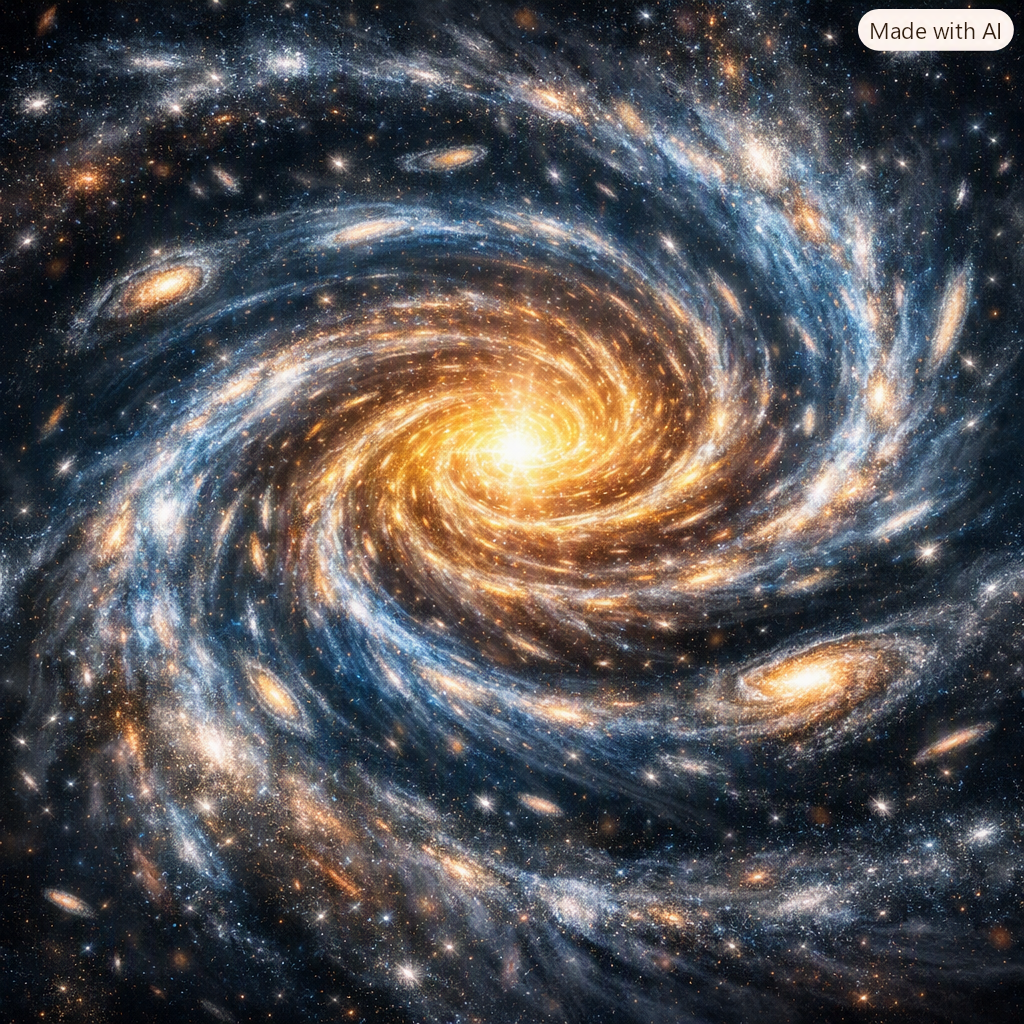
Directional Cosmology of the Rotating Universe
This document proposes a new coherent and geometric interpretation of the structure of the Universe: directional cosmology. It demonstrates that solar systems, galaxies, cosmic filaments, and superclusters are not independent structures, but the fractal manifestations of a single fundamental phenomenon: the rotation of the cosmic fluid.
By treating space‑time as a rotating fluid, the document unifies phenomena that are usually considered separately — the formation of solar systems, the spiral arms of galaxies, the organization of filaments, CMB anisotropies, and accelerated expansion — under a single dynamic: the vortex.
The work establishes a clear hierarchy:
local vortexes (solar systems),
massive vortexes (galaxies),
intergalactic vortexes (filaments),
global vortex (the Universe).
It also explores the possibility of a directional cosmic center, potentially beyond our causal horizon, and identifies the observable signatures of universal rotation.
This document forms a complete theoretical foundation for a fluid, fractal, and directional cosmology, opening the way to a profound reinterpretation of cosmic dynamics.
Taille :
273,71 Ko
Vues :
468
Téléchargements :
12
♥
0
PDF
TorUsNet

TorUsNet 7.0 - Directional Protocol
TorUsNet 7.0 marks a major evolution of an entirely new communication architecture: directional architecture. Designed for the post‑quantum and photonic era, it replaces classical cryptographic mechanisms with a living internal geometry that is non‑derivable and structurally inviolable.
This version introduces a more natural identity — TorUsNet — conceptually aligned with the Tor Browser ecosystem while remaining fully independent. TorUsNet is not a fork: it is a directional transport layer capable of replacing TCP/TLS with a non‑linear internal geometry.
Taille :
514,33 Ko
Vues :
433
Téléchargements :
8
♥
0
PDF
Ordinateur photonique

Articulated Micro-Sphere Optical Cables
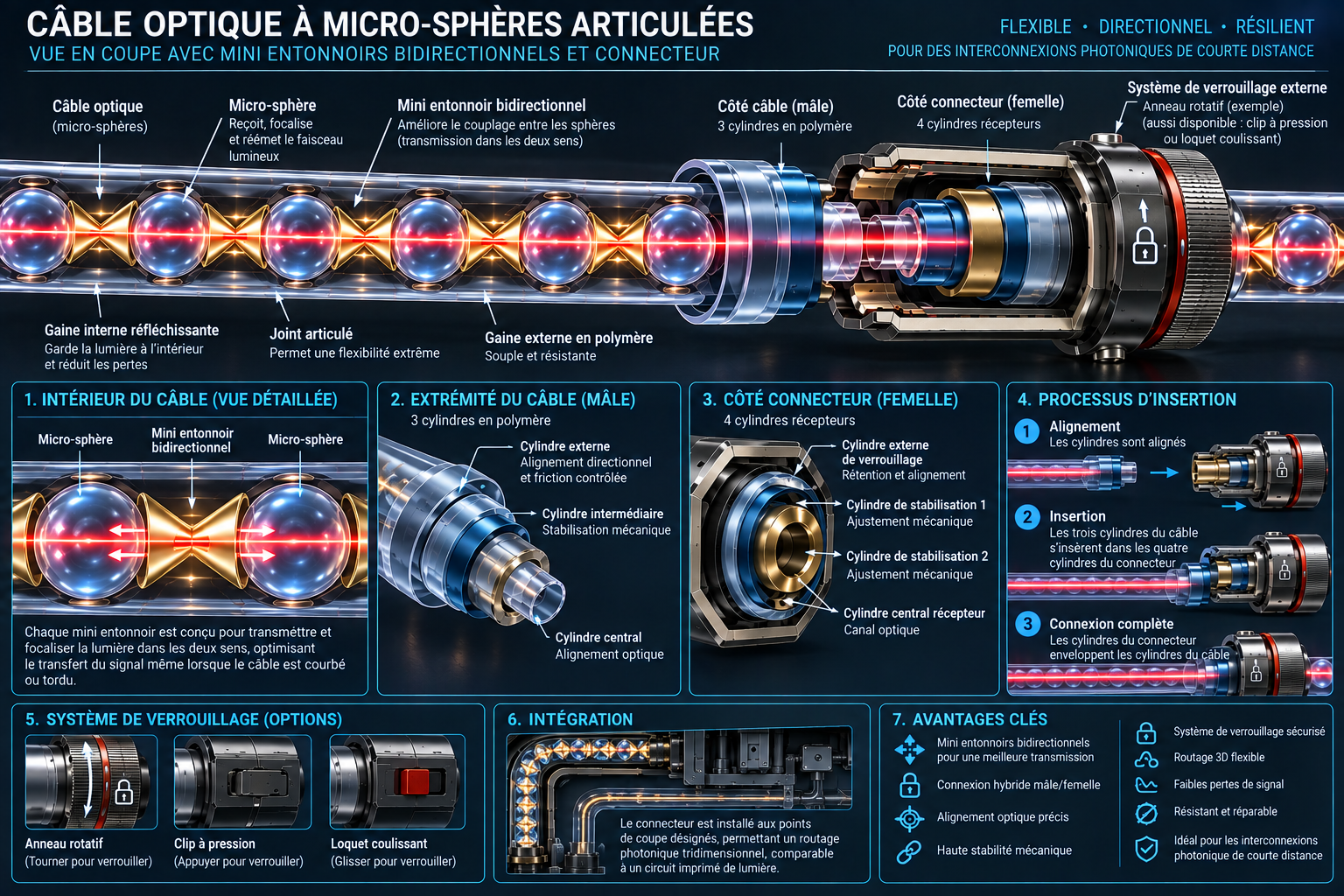
The directional photonic cable is a short‑distance optical link (up to 300 feet) designed for internal photonic systems, directional processors, and photonic routers. It uses articulated micro‑spheres, double‑funnel couplers, and directional connectors, including the L‑shaped gold‑plated mirror connector.
Cable ends rely on a hybrid male/female multi‑cylinder insertion system, ensuring precise alignment and strong mechanical stability.
Taille :
100,70 Ko
Vues :
433
Téléchargements :
10
♥
0
PDF
Mathématique
Advanced Application of Exponential Division
Exponential division, introduced in the first document, is a new geometric operation that describes the internal growth of a space, its progressive densification, and the multiplication of its directions. This second document explores the advanced applications of this operation, showing how it extends to all geometric shapes, volumetric structures, internal confinements, and extreme phenomena such as black holes.
We show that:
almost all geometric shapes can be divided exponentially,
the number of primary directions depends solely on the geometry of the shape,
a cube has 8 primary directions, a triangular pyramid has 4,
a cube can be subdivided into mini‑cubes according to a fixed ratio,
a triangle can be subdivided into smaller triangles until saturation,
exponential division can be directional or volumetric,
internal strings vibrate along dimensions defined by directions,
a black hole is a sphere subdivided exponentially into saturated mini‑spheres,
directional saturation corresponds to maximal confinement,
the extreme density of a black hole is geometric density, not a singularity.
This document extends directional theory toward a deeper understanding of geometry, matter, confinements, and cosmological phenomena. It shows that exponential division is not merely a mathematical operation: it is a universal mechanism capable of describing the internal structure of shapes, dimensions, and astrophysical objects.
Taille :
4,12 Mo
Vues :
417
Téléchargements :
9
♥
0
PDF
Mathématique
The Exponential Division
The Exponential Division
The Exponential Division theory proposes a new way to describe the structure of space by defining directions as real dimensions. From a central point, a sphere is constructed and subdivided according to the fundamental X, Y, and Z axes, producing six elementary directions. Each direction represents a dimension accessible to the observer.
The sphere is then subjected to an exponential division: each region subdivides into new regions, multiplying the number of possible directions according to a progression of the form 6k. This geometric operation, which does not exist in classical mathematics, makes it possible to calculate the complete directional structure around a given point.
In this theory, dimensions are relative to the observer: depth, orientation, and the perception of a dimension depend on the direction in which each person looks. Two observers oriented differently do not perceive the same dimensions, because each direction constitutes a local dimension.
The theory also relies on a fundamental physical principle: photons can move in all possible directions, but vibrate on a single dimension. Thus, every direction accessible to light corresponds to a real dimension of space.
The exponential division therefore becomes a conceptual tool for calculating the true dimensions, linking geometry, orientation, and the behavior of light.
Taille :
210,03 Ko
Vues :
426
Téléchargements :
9
♥
0
PDF
Ordinateur photonique
Management of Light in the Photonic Computer
Light is the functional core of the photonic computer. It is not merely a signal: it is the structure of computation, the internal geometry, the direction, the density, and the fractal that define every operation. In this architecture, light circulates, divides, recombines, and transforms to produce a directional result that the processor can read directly.
This document, Management of Light in the Photonic Computer, describes in detail:
the bidirectional circulation of rays,
directional division in optical networks,
recombination in return mode,
the use of lasers as emitters and receivers,
optical switches through micro‑rotation,
and the dynamic selection of computation networks.
It constitutes the third conceptual pillar of the photonic architecture.
Documents to read before this one
To fully understand the mechanisms described here, it is strongly recommended to first read the following two documents, which establish the theoretical and material foundations of the photonic computer:
🔹 1. The Photonic Computer https://zenodo.org/records/22149130
This document presents directional logic, computation modes, internal fractals, and the conceptual structure of the photonic processor. It explains why light replaces electronics and how optical networks become computation units.
🔹 2. 3D Printing of the Motherboard and Photonic Processor https://zenodo.org/records/22311343
This document describes the material fabrication: the photonic motherboard, optical networks, division cavities, internal prisms, optical ports, and the three‑dimensional structure that allows light to circulate in multiple directions.
Taille :
237,83 Ko
Vues :
419
Téléchargements :
10
♥
0
PDF
Ordinateur photonique
3D Printing of the Photonic Motherboard and Photonic Processor
This document presents the complete methodology for 3D printing the photonic motherboard and the photonic processor, two central components of the photonic computer. It provides a detailed description of the specialized laboratory required for fabricating three‑dimensional optical structures, the processes for depositing and fusing silica, and the integration of non‑photosensitive polymers to ensure internal isolation of the fiber networks.
The work is structured into three complementary chapters. The first chapter outlines the layout of the photonic laboratory, its functional zones, and the essential equipment needed to handle high‑precision optical materials. The second chapter details the printing process of the photonic motherboard, including its dimensions, its adhesive aluminum base, and the formation of its vertical optical layers. The third chapter describes the fabrication of the photonic processor, a complex directional cube composed of fibers oriented along seventeen fundamental directions, printed layer by layer with alternating silica and polymer to guarantee perfect optical isolation.
This document provides a solid technical foundation for understanding the material construction of the photonic computer and serves as a reference for anyone wishing to study or reproduce its manufacturing principles. To explore the directional theory and scientific foundations of this technology in greater depth, it is recommended to consult the main document available on Zenodo:
https://zenodo.org/records/22149130
Update — Correction on the Number of Layers to Print
An error slipped into the previous version regarding the number of layers to be printed for the photonic processor. The value indicated is not correct: the actual number of layers remains to be determined and is significantly higher than what was initially stated. This section will be updated once the final measurements are established.
Taille :
185,62 Ko
Vues :
422
Téléchargements :
9
♥
0
PDF
Musique
The Reverse Solfeggio
Reverse Solfeggio is an innovative musical framework that redefines the foundations of sound perception, notation, and compositional logic. Unlike traditional solfeggio, which organizes music through linear progressions of time, pitch, and dynamics, Reverse Solfeggio approaches sound as a symmetrical and reversible phenomenon. Every note, interval, and harmonic structure is treated as a dual entity, possessing both a direct form and a mirrored counterpart that preserves internal coherence while revealing new acoustic behaviors.
By inverting fundamental parameters such as attack, decay, harmonic direction, phase, and dynamic flow, Reverse Solfeggio opens a multidimensional space where musical structures can unfold simultaneously forward and backward. This bidirectional logic enables the exploration of sonic matter and harmonic antimatter, offering composers and researchers a novel lens through which to analyze and generate musical forms.
Beyond its artistic implications, Reverse Solfeggio resonates with broader scientific concepts related to symmetry, inversion, and duality found in physics, mathematics, and acoustics. It provides a theoretical and practical foundation for studying reversible sound phenomena, designing new notational systems, and developing experimental compositional techniques.
This document presents the complete structure of Reverse Solfeggio, including its acoustic principles, notation system, inverted scales and modes, psychoacoustic effects, and physical interpretation. It aims to establish Reverse Solfeggio as a coherent and rigorous musical language suitable for contemporary research, artistic creation, and technological innovation.
Taille :
85,48 Ko
Vues :
402
Téléchargements :
7
♥
0
PDF
Ordinateur photonique
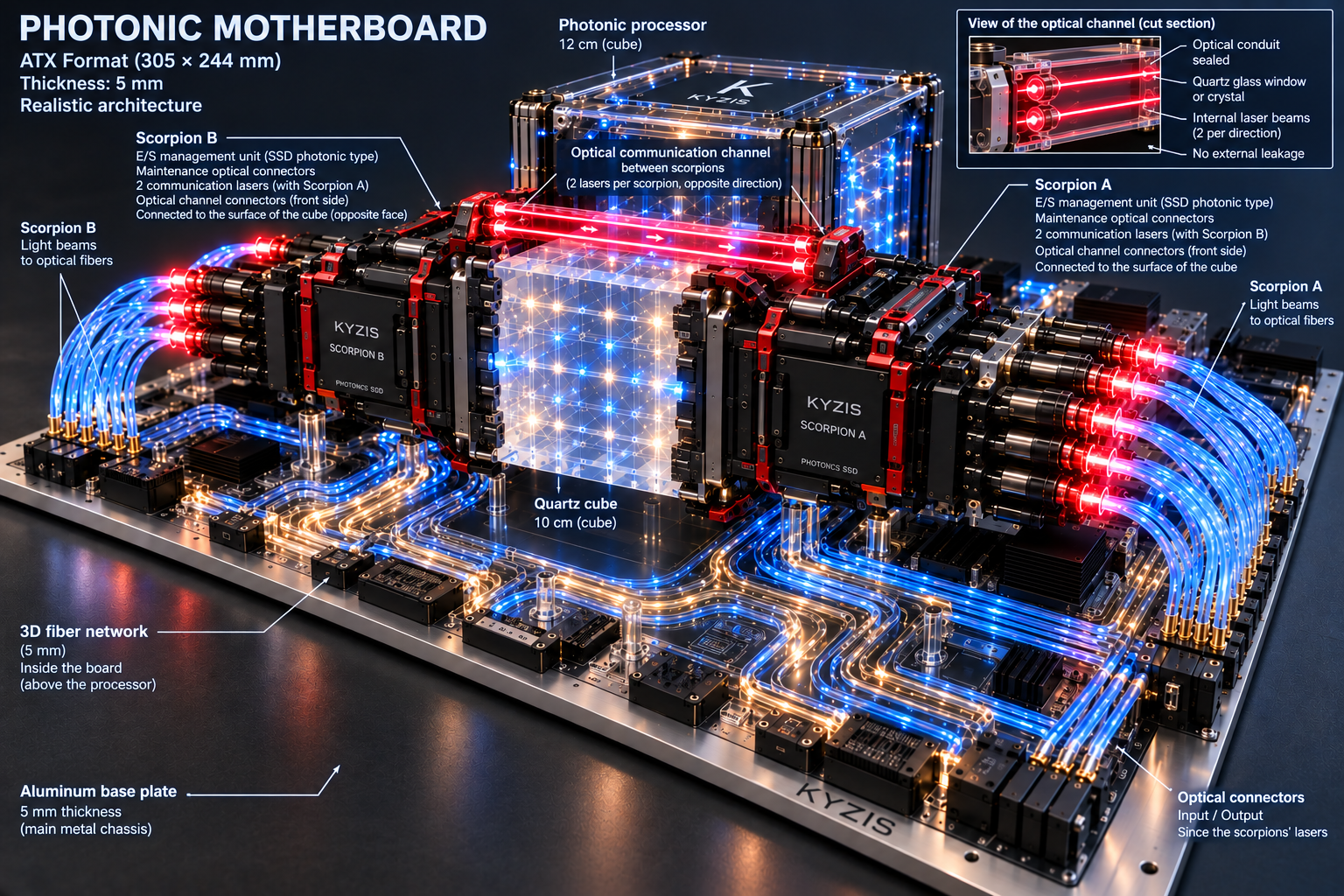
The Photonic Computer
This document presents the first complete architecture based on directional photonic theory, a new science of computation in which light becomes the primary carrier of information, coherence, and structure. It explains how directional geometries, fractals, hyperfractals, and dynamic, adaptive, emergent, and self‑replicating structures can be organized to form a light‑based computer capable of surpassing all existing technologies.
The work explores in depth the fundamental properties of photonic computation:
directional coherence,
multidimensional stability,
luminous synchronization,
fractal and hyperfractal structures,
spatiotemporal dynamics,
internal adaptation mechanisms,
the emergence of new behaviors,
geometric replication,
and the foundations of intelligent computation.
It demonstrates why the photonic computer is superior to the quantum computer: light suffers no decoherence, operates at room temperature, carries more states than a qubit, enables non‑destructive geometries, and offers a level of stability that superconducting systems will never achieve.
This document is not merely a technical description: it is the foundation of a new computational era, where light becomes the universal medium for computation, structure, and evolution.
Taille :
4,53 Mo
Vues :
456
Téléchargements :
5
♥
0
PDF
Ordinateur photonique
Extension of Photonic Processor Arithmetic and Architecture
This document presents a photonic computing architecture in which mathematical operations, numerical structures, and multidimensional representations are defined by optical transformations rather than electronic instructions. Values may be stored in binary when necessary, but their operational form is always directional, fractal, or geometric, enabling unbounded arithmetic.
The fundamental operations — addition, subtraction, multiplication, and division — are performed through optical recombinations or scissions. Exponential divisions make it possible to subdivide a directional volume until saturation, providing a means to compute geometric powers such as squares, cubes, and higher‑dimensional constructs. Exponential structures of the form nnnnn are represented by multi‑level luminous patterns whose stability is ensured by the processor’s internal optical environment.
The read/write heads interpret these structures directly, ensuring continuity between binary storage, photonic representation, and computational execution. This approach enables the manipulation of values and geometries that cannot be represented electronically, establishing a theoretical foundation for fully optical computing capable of processing extreme structures, saturated volumes, and multidimensional calculations with internal coherence.
Taille :
314,42 Ko
Vues :
415
Téléchargements :
7
♥
0
PDF
Ordinateur photonique
New Arithmetic of the Phtonic Processor
This document introduces a computational architecture based on a non‑bounded numerical representation, capable of describing arbitrarily large integers without relying on fixed binary formats. Instead of storing numbers bit by bit, the system encodes them through structured descriptions composed of levels, cycles, fractal patterns, and directional parameters. These compact structures allow the manipulation of extremely large values, including exponential towers such as 2^2^X, where the parameter X determines the depth of the construction.
The architecture operates on a set of self‑modifying binary cases, each defined by a normal bit and its inverse counterpart. When a key traverses these cases, their states invert, continuously altering the internal configuration of the system. This ongoing mutation ensures that each interpretation is unique, preventing prediction, derivation, or exact reproduction of any computational path.
By replacing fixed‑width binary storage with extensible mathematical structures, the system enables a new form of arithmetic in which numbers are treated as dynamic, structured objects rather than static sequences of bits. This approach surpasses the limitations of traditional electronic processors and provides a foundation for computational models capable of handling numerical magnitudes far beyond the reach of conventional architectures.
Taille :
389,59 Ko
Vues :
413
Téléchargements :
7
♥
0
PDF
Propulsion SMD

SMD Propulsion
SMD Propulsion (Dense Matter Spheres)
This document presents a theoretical propulsion approach based on the controlled deformation of space‑time using Dense Matter Spheres (SMDs). Unlike classical propulsion systems based on mass ejection or mechanical thrust, SMD propulsion relies on geometric, directional, and photonic phenomena.
SMDs are composite metallic structures made from ultra‑dense alloys capable of interacting with the Higgs field. When an SMD is set into rotation inside magnetic accelerator rings, its internal strings excite the Higgs field, resulting in:
reduced inertia,
production of directional heat,
partial deconfinement of strings,
and local deformation of space‑time.
Propulsion does not result from a force applied to the spacecraft, but from the creation of a directional geodesic in which the vessel moves. Space‑time is locally reshaped, enabling reactionless and potentially supraluminal translation without violating general relativity.
Synchronization of the SMDs is ensured by a Photonic Computer (OOP), which uses photonic cavities and octonionic logic to harmonize directional signatures at the sub‑femtosecond scale. This system guarantees coherence of the geometric gradients generated by the SMDs and stabilizes the global deformation produced by the VSMD engine.
The VSMD engine (Dense Matter Sphere Vessel Engine) combines:
multiple rotating SMDs,
magnetic accelerator rings,
a geometric confinement module,
a directional interface integrated into the vessel’s structure,
and a photonic synchronization system.
This architecture transforms the rotation of dense matter into controlled geometric deformation, opening the way to supraluminal propulsion without exotic energy, without negative mass, and without violating established physical laws.
This work proposes a conceptual foundation for a new category of propulsion: directional geometric propulsion, where motion is achieved by manipulating the local structure of space‑time.
Taille :
310,89 Ko
Vues :
450
Téléchargements :
6
♥
0
PDF
Ordinateur photonique
Photonic Processor - Directional Computing
Summary of Directional Photonic Computing
Directional photonic computing is a completely new computational architecture in which mathematical values are no longer encoded in binary, but physically embodied through light. Numbers are represented by the optical properties of a beam — color, intensity, phase, polarity, density, and direction — enabling direct, continuous computation without approximation and without electronic logic.
The system is built on three complementary components:
1. Quartz Storage Cube (10 cm³)
It stores data in 5D binary (X/Y/Z position, laser polarity, laser intensity). Its theoretical capacity ranges from 1 to 10 petabytes, with stability lasting millions of years. The cube is pure memory with no internal logic.
2. Read/Write Optical Head (Directional Interface)
It covers the entire X‑Y plane of the quartz cube, on both the top and bottom faces, enabling instantaneous access to any voxel. It converts binary data into directional light and converts light back into binary. It contains all computational logic, including: color tables, intensity tables, calculation modes, exponent cycles, scission and regrouping models, phase and polarity models. It is the brain of the system.
3. Photonic Processor (12 cm Cube)
Printed in active silica, it contains a 3D network of optical structures: scission cavities, regrouping cavities, resonance rings, directional prisms, phase chambers, fractal amplification structures. It has no internal logic; it simply performs the physical transformations defined by the optical head.
Taille :
509,01 Ko
Vues :
403
Téléchargements :
6
♥
0
PDF
Théorie directionnelle
Directional String Theory
Directional String Theory proposes a physical model entirely based on the notion of direction, rather than fixed dimensions or imposed mathematical structures. It is built on a central principle:
A string vibrates in a single internal dimension, and this vibration interacts with an omnidirectional confinement that defines mass, motion, gravity, and cosmological structure.
Within this framework, mass appears as directional tension generated by the interaction between the string and its confinement. Motion results from an internal reorientation of the vibration, transmitted outward through the confinement. Gravity is interpreted as a gradient of directional tension produced by massive confinements, naturally guiding the trajectories of matter and light.
Photons are described as free strings, devoid of confinement, which explains their lack of mass and their fundamental role:
Light reveals the available directions of the Universe.
Directional cosmology presents the Universe as a vibratory fluid, expanding and rotating, where galaxies emerge as directional vortices stabilized by a cosmic centrifugal effect. Dense Matter Spheres (SMDs) represent the maximal state of directional tension, providing a framework for studying local spacetime curvature and photon deviation.
This theory proposes a unified vision in which:
matter is a confined vibration,
light is a free vibration,
gravity is a directional gradient,
dimensions are possible directions,
cosmology is the dynamics of the directional fluid,
extreme states (SMDs) enable experimental tests of local curvature.
Together, these elements form a new conceptual approach, linking microscopic physics, motion dynamics, gravity, and the structure of the Universe through a single principle: direction.
Taille :
510,29 Ko
Vues :
420
Téléchargements :
6
♥
0
PDF
Théorie directionnelle
Directional Theory - Complete Scientific Document
The Directional Theory is an original fundamental physics framework proposing that reality in its totality rests on a single entity — the directional string — defined not as a particle nor as a wave in the classical sense, but as pure energy endowed with an intrinsic direction, vibration, and intensity. From this premise, the theory develops a coherent set of ten principles that allow the major physical phenomena to be reformulated: the formation of particles (through the confinement mechanism), mass (through the relation E₁ + E₂ = Mc²), gravity (as a frequency gradient between confinements), light (as a free, unconfined string), cosmic rotation (as a directional expression at large scale), and the universe itself (as a cyclical system without singularity). The Directional Theory does not reject the great existing theories — it reinterprets and unifies them from a more fundamental level of abstraction, proposing clear distinctions with respect to Einstein's relativity, standard string theory, and quantum mechanics.
Taille :
400,17 Ko
Vues :
425
Téléchargements :
8
♥
0
PDF
Mathématique
The Kyzis Theorem
The Kyzis Theorem proposes a geometric growth law based on a simple recurrence relation applied to a fundamental dimension of an object: the edge of a cube, the radius of a sphere, the height of a cylinder, or a parameter of a torus.
Taille :
403,85 Ko
Vues :
867
Téléchargements :
6
♥
0