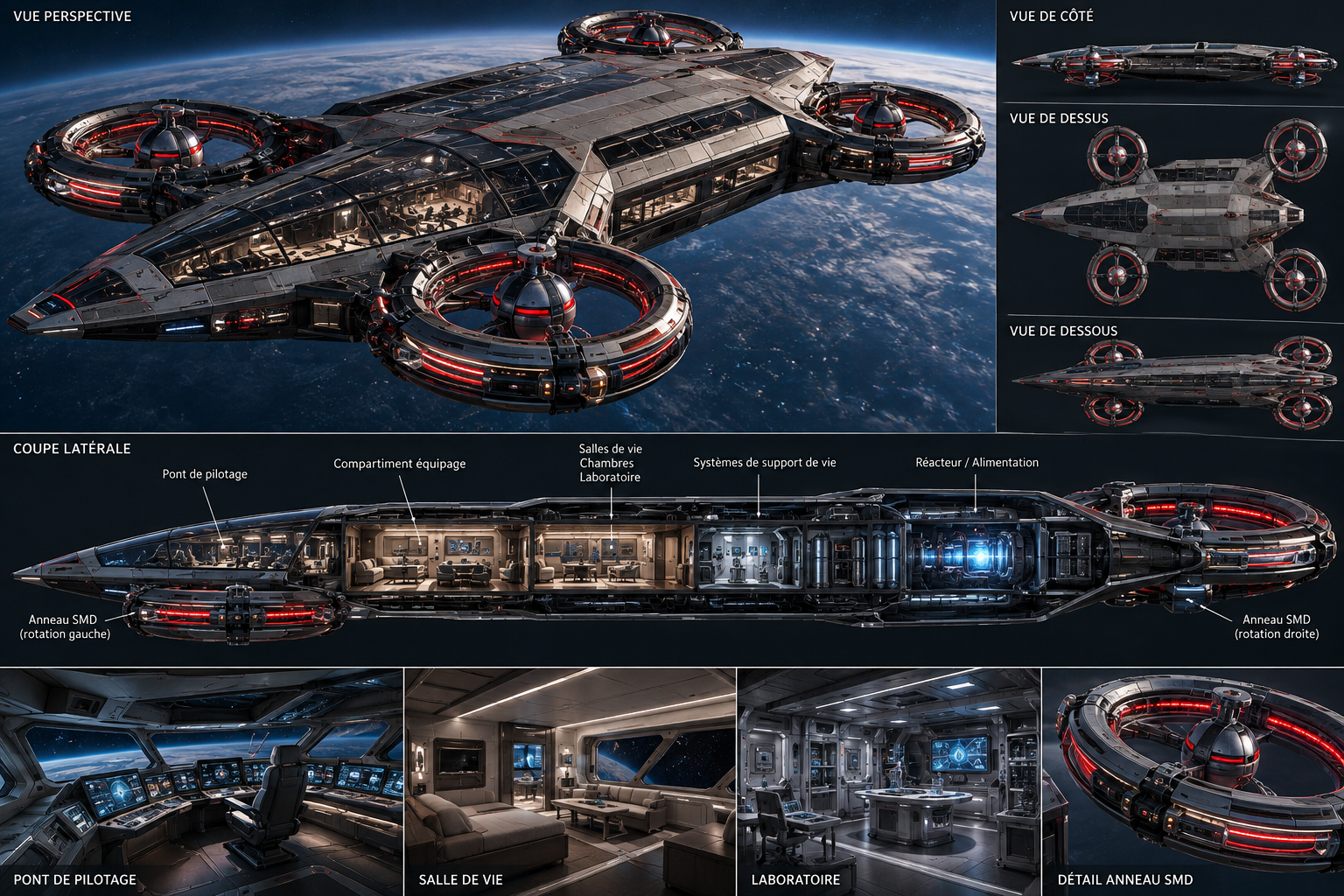
Overview
SMD Propulsion (Dense Matter Spheres)
This document presents a theoretical propulsion approach based on the controlled deformation of space‑time using Dense Matter Spheres (SMDs). Unlike classical propulsion systems based on mass ejection or mechanical thrust, SMD propulsion relies on geometric, directional, and photonic phenomena.
SMDs are composite metallic structures made from ultra‑dense alloys capable of interacting with the Higgs field. When an SMD is set into rotation inside magnetic accelerator rings, its internal strings excite the Higgs field, resulting in:
reduced inertia,
production of directional heat,
partial deconfinement of strings,
and local deformation of space‑time.
Propulsion does not result from a force applied to the spacecraft, but from the creation of a directional geodesic in which the vessel moves. Space‑time is locally reshaped, enabling reactionless and potentially supraluminal translation without violating general relativity.
Synchronization of the SMDs is ensured by a Photonic Computer (OOP), which uses photonic cavities and octonionic logic to harmonize directional signatures at the sub‑femtosecond scale. This system guarantees coherence of the geometric gradients generated by the SMDs and stabilizes the global deformation produced by the VSMD engine.
The VSMD engine (Dense Matter Sphere Vessel Engine) combines:
multiple rotating SMDs,
magnetic accelerator rings,
a geometric confinement module,
a directional interface integrated into the vessel’s structure,
and a photonic synchronization system.
This architecture transforms the rotation of dense matter into controlled geometric deformation, opening the way to supraluminal propulsion without exotic energy, without negative mass, and without violating established physical laws.
This work proposes a conceptual foundation for a new category of propulsion: directional geometric propulsion, where motion is achieved by manipulating the local structure of space‑time.