Théorie directionnelle
The Curvature of Spacetime in Potential Dimensions
Version 1.0
English
PDF
337,81 KB
Author
L'Architech (Gabriel Breton-Breault)
Publication
31 October 2026
Views
37
Downloads
0
Likes
0
Click the image to enlarge it — click again in the viewer to zoom.
Overview
Introduction: The Curvature of Spacetime in Potential Dimensions
Spacetime curvature is commonly represented as a deformed surface, for example, a sheet distorted by a mass. This image is intuitive, but it does not depict a geometry that acts simultaneously in all directions of space.
This document proposes a different approach derived from directional physics. It does not begin with curvature itself, but with a redefinition of dimension. A dimension is no longer considered a fixed axis (X, Y, or Z). Instead, it is a directional possibility accessible from a given position: it associates a position with a direction, to which the directional density of the region is added. A dimension therefore does not need to be rectilinear. If successive directions remain aligned, the dimension is straight. If they change progressively, it is curved.
The document develops this idea in five stages:
Chapter 1, Potential Dimensions: the definition of dimension, the distinction between potential and effective dimensions, the granularity of space, and directional density.
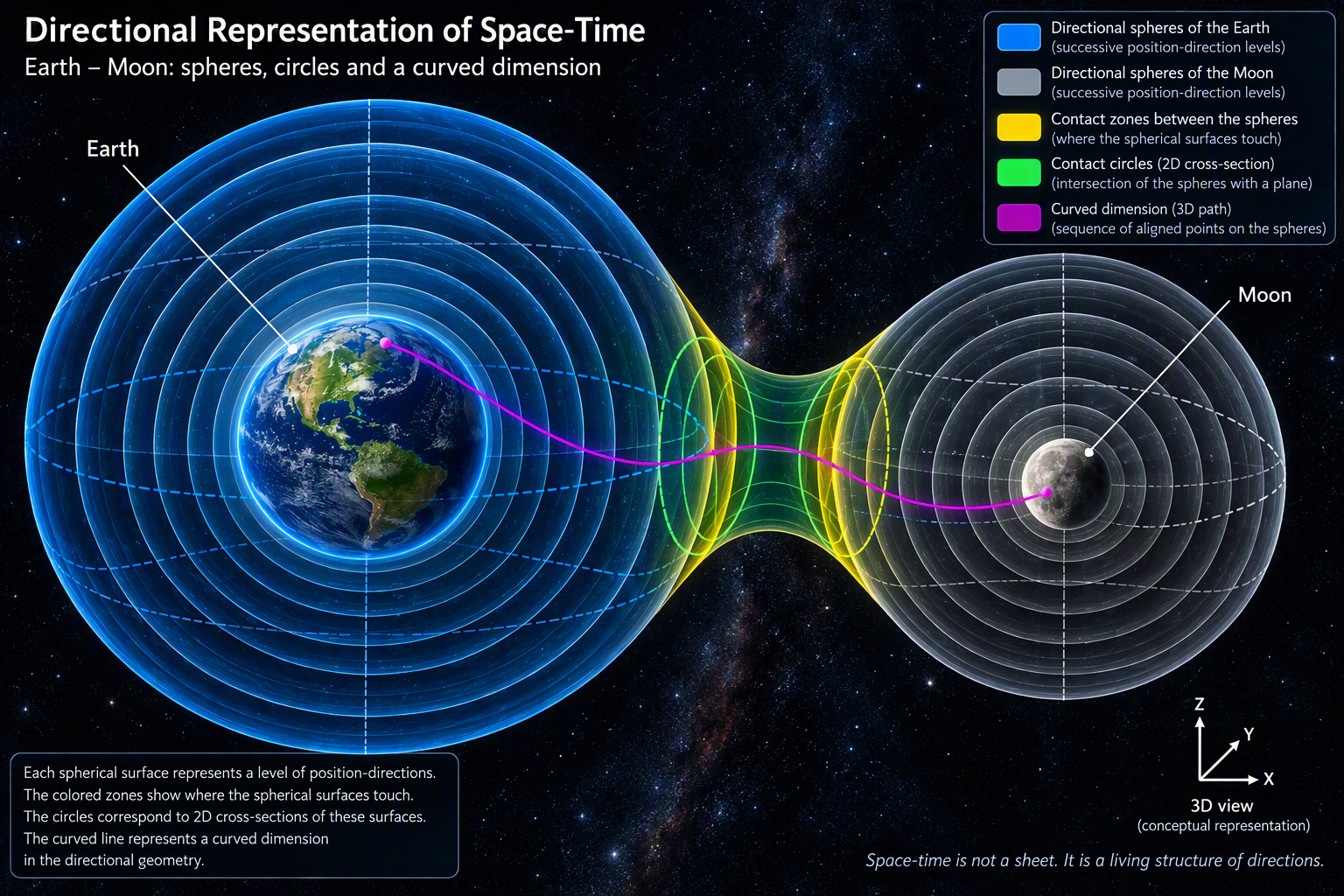
Chapter 2, Spheres: a succession of spherical surfaces around a center represents three-dimensional space, both around a mass and between two masses (the Earth and the Moon).
Chapter 3, Circles: a planar cross-section transforms the spheres into circles. This makes it possible to isolate the corresponding position-direction pairs and examine the structure in two dimensions.
Chapter 4, Curves: by following these positions from one circle to another, a line emerges. It becomes a curve when its orientation changes. This chapter also distinguishes between local curvature and global curvature.
Chapter 5, The Whole: by bringing together all curves and all densities, curvature becomes omnidirectional and volumetric. It becomes a property of the collective organization of dimensions.
The complete progression can be expressed as follows:
potential dimensions → spheres → circles → curves → directional whole
Within this framework, a mass is no longer an object that depresses a sheet. Instead, it exists within a three-dimensional directional geometry, and global curvature emerges from the local organization of positions and directions.